What Makes Up the Landed Cost of Imported Furniture?
A furniture quote covers only the factory gate. Here is the full landed cost formula for importers — FOB, freight, Australia duty, GST and biosecurity — with a worked example.
On this page
- What is landed cost, and why is the factory quote only half the story?
- What goes into the landed cost formula?
- FOB, CIF or EXW — where does the calculation start?
- How much does shipping add per piece when importing to Australia?
- What are the Australia import charges: duty, GST and biosecurity?
- Is GST really a cost, or can you claim it back?
- Worked example: a container of chairs landed in Sydney
- What do importers most often leave out of landed cost?
- How do you compare two quotes on landed cost?
A furniture quote from a Chinese factory usually shows one number: the ex-works or FOB unit price. But that number is the price of making the piece, not the price of having it on your shelf. Landed cost is the full cost from the factory gate to your warehouse — and for furniture it normally runs 20–50% above the quoted price once freight, duty, tax and clearance are counted. This guide breaks the formula down line by line, with the Australia-specific charges (ChAFTA duty, 10% GST, BMSB biosecurity) made explicit, and a worked example for a container of chairs landed in Sydney.
What is landed cost, and why is the factory quote only half the story?
Landed cost is the complete cost of a shipment from the factory gate to your door, expressed either for the whole container or per unit. The factory quote, by contrast, is the price of one input among seven or eight. The gap is not a rounding error: furniture is bulky and low-density, so freight and handling are a large share of the total, and duty and tax follow the shipment, not the piece. Buyers who set retail prices or margins on the FOB number discover the difference at the import invoice — after customer pricing is already committed.
What goes into the landed cost formula?
Landed cost is additive. Start from the goods value and add every cost incurred between the factory and your warehouse:
Landed cost (per shipment) = FOB goods value + inland China freight (if quoted EXW) + ocean freight + marine insurance + import duty + port and terminal handling + customs brokerage + biosecurity / BMSB fees + inland delivery + GST (Australia: 10%).
Landed cost (per unit) = total shipment cost ÷ units in the container. When GST is recoverable for a registered business, run a second per-unit figure excluding GST so the margin math reflects the permanent cost.
Every one of those lines is a real number a broker or forwarder can quote you. None of them appear in a supplier’s unit price, which is exactly why they get left out of early calculations.
FOB, CIF or EXW — where does the calculation start?
It starts wherever your quote stops, and that depends on the Incoterm. Under the Incoterms 2020 rules, EXW (ex-works) puts the goods at the factory and leaves inland China transport and export clearance to you; FOB (free on board) carries the goods to the named port and onto the vessel; CIF (cost, insurance, freight) adds ocean freight and insurance to the destination port. Most Chinese furniture quotes arrive as FOB or EXW. If you are quoted EXW, add inland China trucking and export documentation before the formula begins. If you are quoted CIF, the freight and insurance lines are already inside the goods value and must not be added twice.
How much does shipping add per piece when importing to Australia?
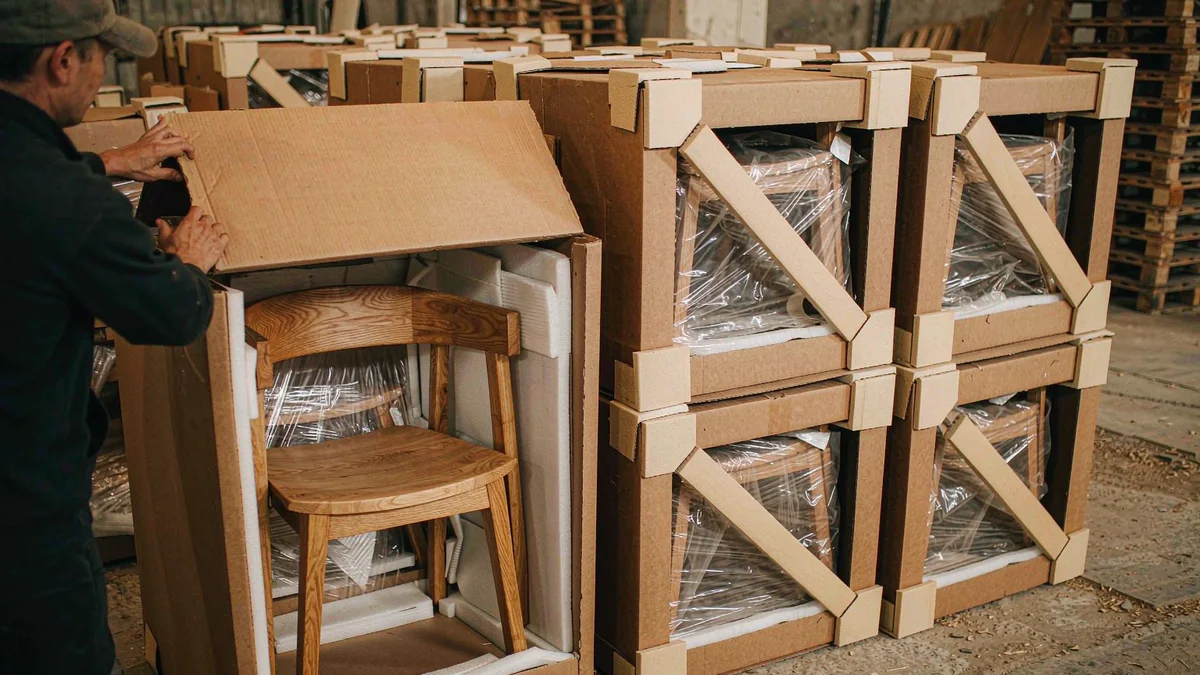
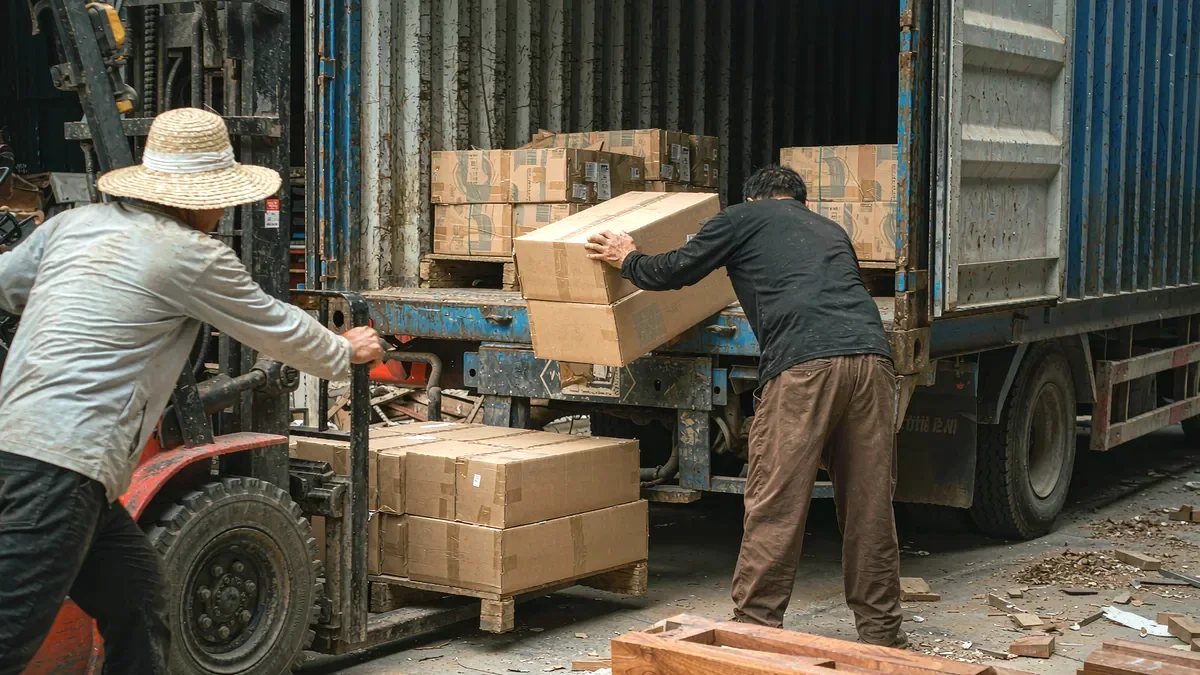
Nothing per piece — freight is billed by volume, and furniture cubes out a container long before it weighs out. A 40-foot high cube gives roughly 65–75 usable cubic metres. Recent China-to-Sydney rates run about US$4,400–5,700 per 40HQ, port to port. Divide that by the units the container actually holds, and the freight line per chair can be several dollars even when the factory price is tens of dollars. A better-packed carton that nests tightly can drop the per-unit freight by more than a negotiated unit-price discount is worth — which is why our dining tables and chairs are engineered for knock-down packing rather than shipped assembled.
What are the Australia import charges: duty, GST and biosecurity?
Three charges apply at the Australian border, and they behave differently from the US or EU:
- Customs duty. Most wooden and upholstered furniture from China enters at 0% under ChAFTA, provided the shipment carries a valid Certificate of Origin. Without it, the general rate applies — commonly around 5% for furniture under HS headings 9401 and 9403. The certificate is not paperwork you fix later; get it right at the origin or you pay the general rate.
- GST. Charged at 10% on the value of the taxable importation — the customs value plus international freight, insurance and any duty — and collected at the border by the ATO. For GST-registered businesses it is generally recoverable, so it is a cash-flow item, not a permanent cost.
- Biosecurity. The BMSB offshore treatment in the risk season (roughly September to April) is a per-container cost arranged before loading, plus any inspection or treatment directed by the department on arrival. It is the charge most generic calculators omit.
Wood packaging material crossing the border must also meet ISPM 15 — heat-treated or fumigated and stamped — or the container can be held at port.
Is GST really a cost, or can you claim it back?
For most importers, it is recoverable rather than permanent. GST-registered businesses claim the import GST as an input tax credit, so the 10% does not stay in the product’s cost the way duty does. If you are not registered, or you import for final resale without registration, it is a real cost you must recover through your selling price. The practical move is to model both: a landed cost including GST (your cash outlay at the border) and a landed cost excluding GST (your permanent unit cost for margin). A shipment that looks thin on the first figure may be healthy on the second — and vice versa.
Worked example: a container of chairs landed in Sydney
Take 600 solid timber dining chairs at a FOB price of US$55 each in a single 40HQ to Sydney.
| Line | Amount (USD) | Note |
|---|---|---|
| FOB goods value (600 × $55) | $33,000 | Factory gate |
| Ocean freight (40HQ to Sydney) | $5,000 | Mid-range of $4,400–5,700 |
| Marine insurance (0.3% of CIF) | $114 | CIF ≈ $38,114 |
| Import duty (ChAFTA, with CoO) | $0 | 0% under ChAFTA |
| Port & terminal handling | $550 | THC + documentation |
| Customs brokerage | $450 | Per shipment |
| Biosecurity / BMSB treatment | $450 | Risk-season, offshore |
| Inland drayage (port to warehouse) | $500 | Sydney metro |
| Logistics & import (ex-GST) | $7,064 | Added on top of goods |
| GST (10% of taxable value) | $3,811 | On CIF + duty |
| Total landed, including GST | $43,875 | |
| Landed per unit (incl. GST) | $73.13 | +33% over FOB |
| Landed per unit (ex-GST, registered) | $66.77 | +21% over FOB |
The chairs leave the factory at $55 and land at roughly $73 including GST — a 33% markup, driven almost entirely by freight and handling, with duty contributing nothing thanks to ChAFTA. For a GST-registered importer the permanent cost is closer to $67, a 21% markup. Either way, the unit price told you none of it.
What do importers most often leave out of landed cost?
Five items, in order of how often they are forgotten: biosecurity / BMSB treatment (Australia-specific, seasonal); damage allowance (a 2–4% first-container damage rate is normal, and air-freighting replacements during a season is expensive); peak-season freight surcharges (ocean rates swing with the calendar); demurrage and detention (a container sitting past the free-storage window because clearance was late); and inland delivery and devanning at the destination. None of these is exotic, and all of them are predictable. The mistake is treating them as contingencies instead of line items — once they are written into the sheet, the comparison between two suppliers stops being a guess.
How do you compare two quotes on landed cost?
Build one sheet with the same lines for every supplier and fill it in the same currency: goods value, inland freight, ocean freight, duty and clearance, a damage allowance, and delivery. Freight needs carton volume multiplied by units, then divided by usable container capacity — ask each factory for carton dimensions and units per container rather than estimating. Once every quote carries the same lines, compare the bottom total and the per-unit landed figure, not the unit price at the top. The full step-by-step method for running that comparison across suppliers is covered separately in why the cheapest quote is not always the lowest cost.
Landed cost is not a spreadsheet exercise to fear — it is the number that decides whether an import order makes money. Calculate it per unit, on the same basis for every supplier, before you commit a margin, and the factory quote finally tells you the truth.
If you would like a second pair of eyes on a quote you are weighing up, send the specification and the packing details and we will work the landed cost through with you — by email or on WhatsApp. No obligation, and no charge for the arithmetic.
Frequently Asked Questions
What is the difference between FOB and landed cost?
FOB (Free On Board) is the price of the goods delivered onto the vessel at the named Chinese port — it covers manufacturing plus inland China transport and export handling. Landed cost is everything from that point to your warehouse: ocean freight, insurance, import duty, port and clearance fees, biosecurity, domestic delivery, and GST. FOB is one line on the landed cost sheet; for furniture, the lines below it usually add 20–50% on top.
How much duty do I pay importing furniture from China to Australia?
Most wooden and upholstered furniture from China enters Australia at 0% customs duty under ChAFTA, provided the shipment is accompanied by a valid Certificate of Origin issued under the agreement. Without that certificate, the general (non-preferential) rate applies — commonly around 5% for furniture under HS headings 9401 and 9403. Duty is assessed on the customs value, which for FOB terms is the goods value plus international freight and insurance. Confirm the exact rate for your HS code with a licensed broker, because the rate follows the product, not the supplier.
Is GST a real cost when importing furniture into Australia?
GST is charged at 10% on the value of the taxable importation — broadly the customs value plus freight, insurance and any duty — and it is collected at the border by the ATO. For GST-registered businesses it is generally recoverable as an input tax credit, so it is a cash-flow item rather than a permanent cost. If you are not registered, or you are importing for final resale without registration, it is a real cost. Model both figures: landed cost including GST, and landed cost excluding GST for a registered entity.
What is the BMSB treatment and why does it appear on furniture shipments?
The Brown Marmorated Stink Bug (BMSB) is a biosecurity risk that Australian authorities manage with a seasonal offshore treatment requirement, roughly September through April each year. Furniture and wooden components from China can fall under this regime, and the treatment — fumigation or heat treatment arranged before the container is loaded — is billed per container. It is a genuine Australia-specific cost that generic landed-cost calculators, built around US or EU assumptions, routinely leave out. Check the current risk-season window against your ship date before you quote freight.
How much does ocean freight add per piece of furniture?
Freight is billed by the container or by cubic metre, not by piece, so the per-unit number depends almost entirely on how much volume each carton occupies. A 40-foot high cube gives roughly 65–75 usable cubic metres. At recent China-to-Sydney rates of about US$4,400–5,700 per 40HQ port-to-port, a chair that ships in 0.18 cbm costs far less per unit than the same chair in 0.24 cbm, even though the factory price is identical. That is why carton design and knock-down packing matter as much as the unit price.
Should I compare suppliers on landed cost or unit price?
On landed cost — always. Two quotes for the same chair are rarely the same chair, and even when they are, the packing, freight volume, damage rate, duty treatment and timing differ. Put every quote into one sheet with the same lines — goods value, inland freight, ocean freight, duty and clearance, a damage allowance, and delivery — then compare the bottom total and the per-unit landed figure, not the headline unit price. The companion article explains how to run that comparison across suppliers step by step.
Sources & References
Get a furniture quote
Sourcing solid wood furniture for your market? Send us your drawings, target quantities, and destination port — we will reply with pricing, MOQ, and lead time.