Why Is the Cheapest Furniture Quote Not Always the Lowest Cost?
A cheaper furniture quote often costs more once packing, freight volume, damage rates and delays are counted. Here is how to compare landed cost across suppliers instead of unit price.
On this page
- What does a furniture quote actually include?
- Why do two quotes for the same chair differ by 30%?
- How much does packing change the landed cost?
- What does shipping actually cost per piece?
- What happens when 3% of the container arrives damaged?
- How much does a two-week delay really cost?
- What should you ask for instead of a cheaper price?
- How do you compare landed cost across suppliers?
Two factories quote you the same oak dining chair. One says $48, the other says $61. The cheaper number looks like an obvious decision, and on a spreadsheet it is — right up to the point where the cartons arrive oversized and eat a fifth more container space than you planned, nine chairs come off the truck with scuffed seats, and the replacements have to fly rather than sail because the season has already started. The $13 you “saved” per chair is gone, and then some.
This is not an argument for paying more. It is an argument for comparing the right number. A unit price is the cost of making the piece; landed cost is the cost of having it on your floor, sellable, on time. For furniture importers those two figures frequently come out in the opposite order to the one the quotes suggest.
What does a furniture quote actually include?
Usually the ex-works unit price, and very little else.
Most quotes that arrive from China quote a unit price under EXW or FOB terms and stop there. Under the Incoterms 2020 rules published by the International Chamber of Commerce, those terms define who pays for transport and who carries risk at each handover point — but they say nothing about how the piece is packed, how much space it occupies, what happens if a carton arrives crushed, or what the factory will do about it. All of that is either assumed or left out.
So the quote you are comparing is the price of one input among six or seven. What is missing is normally: packing specification, carton dimensions and volume, units per container, lead time and its trigger, a damage and claim process, the after-sales parts policy, and whether the finish and hardware have been specified by code or left to the factory’s discretion. Each of those is worth real money, and none of them appear in the number you were asked to compare.
Why do two quotes for the same chair differ by 30%?
Because they are rarely quoting the same chair.
A 30 percent gap on a wood dining chair is almost never a difference in efficiency. It is a difference in specification that has not been written down. Timber grade is the first one: a frame cut from upper-grade lumber with fewer and smaller knots costs more than the same frame cut from lower-grade stock, and both look identical under a finish. Panel thickness is the second — an 18 mm drawer bottom and a 15 mm one are indistinguishable in a photograph and differ in material cost and in how the drawer feels after two years.
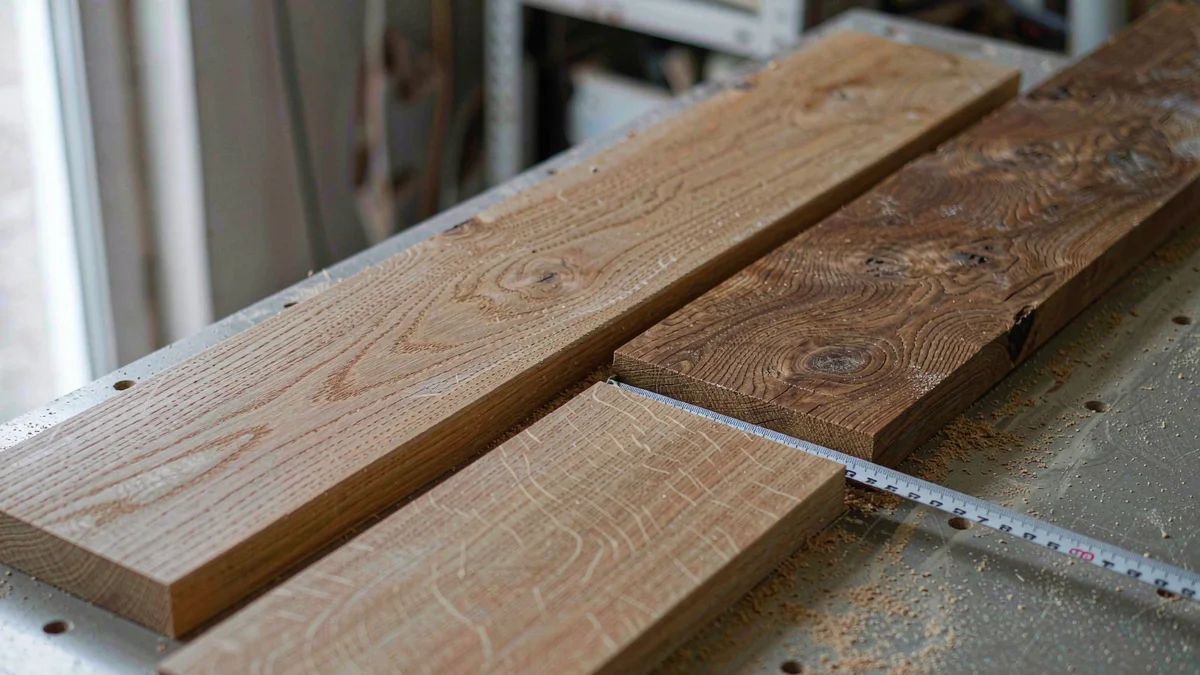
Then come the things a buyer cannot see at all: how many coats of finish and what type, whether a drawer runs on branded soft-close hardware or a generic slide, whether a rail is joined with mortise and tenon or with dowel and screw. Each one moves cost by a few percent and moves service life by years. None of them are visible in a showroom sample, and none of them will be volunteered in a quote that only has to state a price.
The way to make this comparable is unglamorous and quick: send one specification sheet to every factory and require that the quote restate it. Species and grade, panel thickness, joinery, finish system by code, hardware by brand. If two factories will not quote against the same sheet, you do not have two quotes — you have two different products with the same photograph.
How much does packing change the landed cost?
More than most buyers expect, and through two separate channels: freight volume and damage rate.
Packing is where a cheap quote gets expensive quietly. Flat-packing a table can roughly halve its shipped volume compared to shipping it assembled, but flat-pack means assembly labour at the destination and a higher risk of a customer damaging it during assembly. Shipping assembled costs more cubic metres and needs better surface protection. Neither is universally right — the correct answer depends on your labour cost and your customer — but the point is that the choice is worth real money, and it is a choice, not a default.
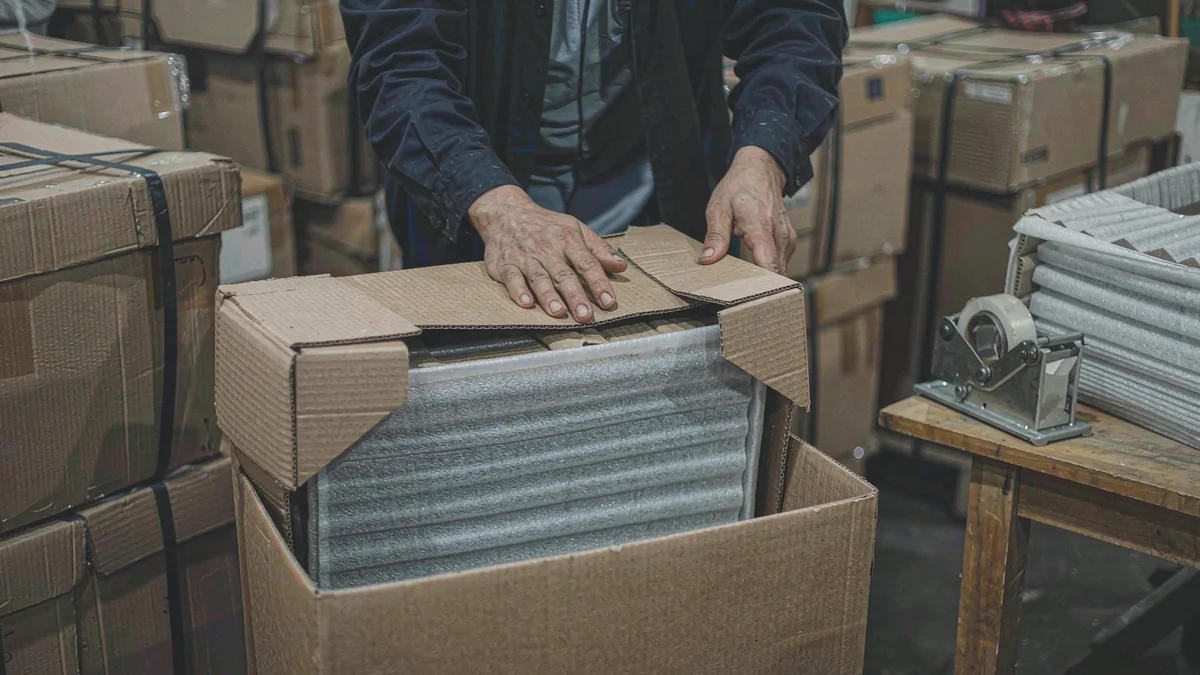
Two details are worth specifying explicitly. Wood packaging material crossing most borders has to meet ISPM 15 — heat-treated or fumigated and stamped — and a container held at port because a pallet lacks the mark costs more than the pallet does. And cartons intended for a long transit should be tested rather than assumed: the International Safe Transit Association publishes drop and vibration procedures that any competent factory can run, and the test report is the cheapest damage insurance available.
What does shipping actually cost per piece?
Nothing per piece — freight is billed by volume, so a design that nests badly can cost more to ship than to make.
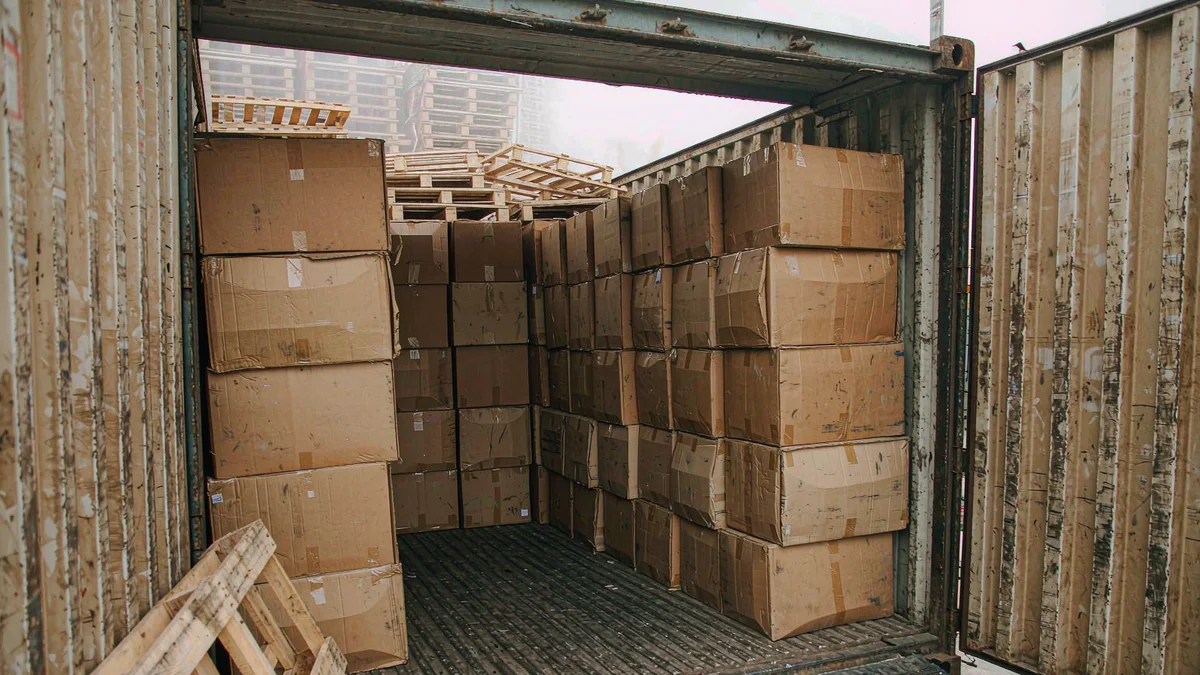
This is the single most useful arithmetic in furniture sourcing. A 40-foot high-cube container gives you roughly 65 to 75 usable cubic metres depending on how well the load is planned. If your carton is 0.22 cubic metres and you order 300 units, that is 66 cubic metres — a full container. If a better-packed version of the same chair comes in at 0.18 cubic metres, 300 units takes 54 cubic metres, leaving room in the container for something else or bringing the whole shipment under one freight charge.
At a freight rate around $95 per cubic metre, the difference between those two cartons is 12 cubic metres, or about $1,140 on the shipment — roughly $3.80 per chair, purely from carton design. That is before any conversation about damage. A factory that has thought about nesting, knock-down design and carton size is not being clever; it is quoting you a lower landed cost without changing its price.
What happens when 3% of the container arrives damaged?
The unit-price saving is gone, and you are left managing the consequence during the season you were protecting.
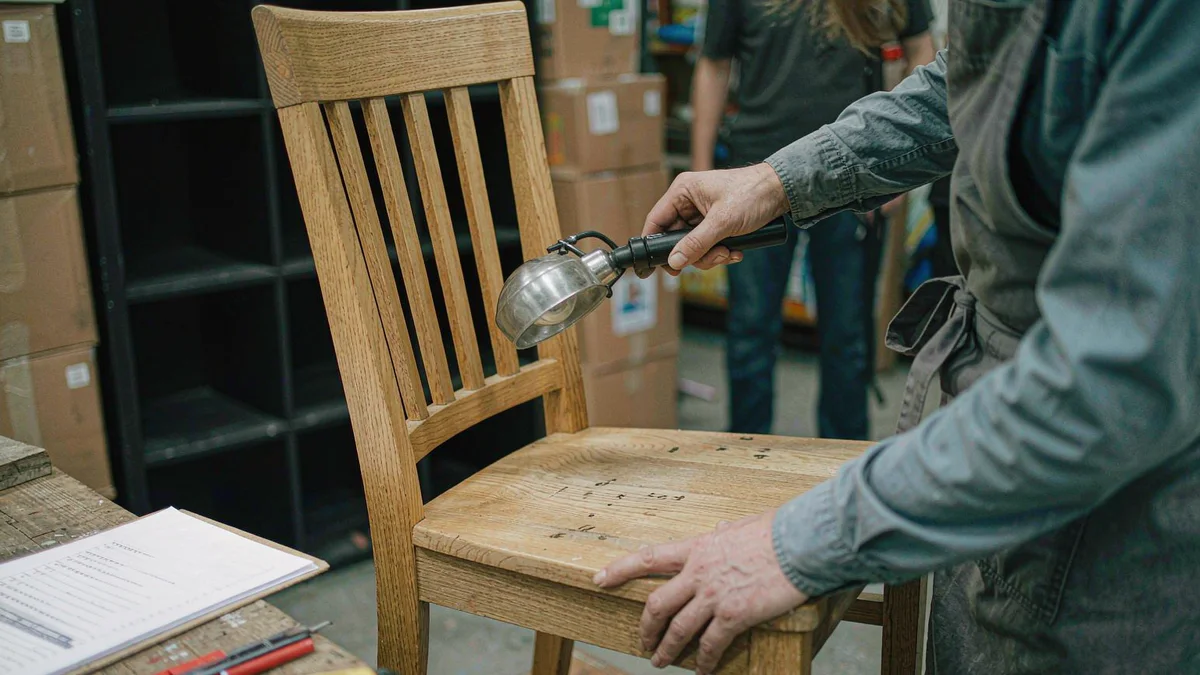
Run it for 300 chairs. Three percent is nine units. At $48 each the replacement goods cost $432, which sounds survivable. But nine bulky chairs cannot wait four weeks for a replacement sailing if the selling window is open now, so they fly — and air freight on nine cartons of furniture typically runs into four figures. Add the handling, the claim correspondence, the photographs, and the retail chargeback if your customer was waiting on those units, and the real figure lands somewhere between $2,500 and $3,500.
Spread across 300 units that is eight to twelve dollars per chair — which is, not coincidentally, about the size of the discount you were pleased about. And the arithmetic gets worse, not better, if the damage is concentrated at the start of a season rather than spread across it.
This is why the damage allowance belongs in the comparison sheet rather than in the contingency budget. A supplier at 0.5 percent and a supplier at 4 percent are not quoting the same product, whatever their unit prices say.
How much does a two-week delay really cost?
Usually more than the price difference you spent three emails negotiating.
A container that arrives two weeks late into a selling season has three costs, and only one of them is freight. There is the expedited transport to recover the schedule. There is the markdown, because stock that lands after the peak has to be priced to move rather than priced to margin. And there is the cash — the goods were paid for weeks before they could be sold, and in a seasonal business that gap is a financing cost even when nobody calls it one.
Take an order with $20,000 of goods value landing two weeks into a season that has already turned. A 15 percent markdown on the affected units to clear them is $3,000, against a price difference of perhaps $3,900 across the whole order if you had taken the more expensive supplier. Almost the entire negotiation, spent, for nothing.
Which is why a lead time needs to state its trigger — sample approval or deposit, not order date — and what happens when it is missed. A modest per-week penalty capped at a small percentage is not there to punish anyone; it changes which order gets scheduled first when the factory is short of capacity.
What should you ask for instead of a cheaper price?
A full breakdown on one fixed specification, so that every factory is pricing the same product and you can see where the money actually goes.
Ask for seven things, in the same email, from every supplier: a specification sheet restated line by line against yours; the packing method, carton dimensions and cartons per container; units per container; the Incoterm and named port; lead time with its trigger and a late-delivery clause; the damage and claim process; and the after-sales parts policy and warranty. Factories that have these answers give them quickly. Factories that do not will say the price is the price — and that is itself useful information, delivered for the cost of one email.
None of this requires an adversarial relationship. It requires that the comparison be possible. A supplier quoting transparently on a full breakdown is usually a supplier that knows its own numbers, and those are the suppliers where the landed cost is lowest to begin with.
How do you compare landed cost across suppliers?
Put every quote into one sheet with the same six lines, then compare the total rather than the unit price. The full line-by-line formula — with the Australia-specific duty, GST and biosecurity lines made explicit — is in how to calculate furniture landed cost.
Here is the same order — 300 chairs — priced two ways. Supplier A is cheaper per unit and worse on everything else. Supplier B is $13 more expensive per chair and better packed, more consistent, and on time.
| Line | Supplier A | Supplier B |
|---|---|---|
| Goods value | $14,400 (300 × $48) | $18,300 (300 × $61) |
| Packing | $3,300 | $2,700 |
| Freight (66 cbm / 54 cbm at $95) | $6,270 | $5,130 |
| Duty and clearance at 5% of goods | $720 | $915 |
| Damage and replacement (4% / 0.5%) | $2,976 | $492 |
| Delay exposure | $3,000 | $0 |
| After-sales reserve | $400 | $150 |
| Total landed | $31,066 | $27,687 |
| Landed per unit | $103.55 | $92.29 |
Supplier A looks $13 cheaper per chair and lands $11.26 more expensive. The gap is not in the negotiation — it is in packing volume, damage rate and timing, three things the unit price never mentioned.
This is the whole argument in one table. The cheapest quote is a statement about one line. Landed cost is a statement about the order. If you only ever compare the first one, you will keep choosing Supplier A, and you will keep wondering why the margin does not behave the way the spreadsheet said it would.
Landed cost is also just one dimension of a wider supplier decision. If you are weighing two or three factories at once, How Do You Compare Furniture Suppliers Before You Commit? places this arithmetic inside a full scoring card — alongside consistency, capacity, packaging and the red flags that disqualify a factory outright.
If you would like a second pair of eyes on a quote you are weighing up, send the specification and the packing details and we will work the landed cost through with you — by email or on WhatsApp. No obligation, and no charge for the arithmetic.
Frequently Asked Questions
How do I compare landed cost between two furniture suppliers?
Build one sheet with the same six lines for every supplier and fill it in the same currency: goods value, packing cost, freight cost, duty and clearance, an allowance for damage and replacement, and an after-sales reserve. Freight needs carton volume multiplied by units, then divided by usable container capacity — ask each factory for carton dimensions and units per container rather than working it out yourself. Once every quote has the same six lines, compare the bottom total and the per-unit landed figure, not the unit price at the top. Suppliers will often volunteer the packing and freight lines if you ask for them as part of the quote rather than as a follow-up question, which makes the comparison far faster.
Is FOB always better than EXW for furniture imports?
Not always, but it is usually clearer. Under EXW you take responsibility for getting the goods out of the factory, which means you control inland haulage and export clearance — fine if you have a reliable agent, risky if you do not, because delays at that stage are yours to solve. FOB moves the goods to the named port and on board the vessel, so the factory handles inland transport and export formalities, and the cost difference between the two is usually smaller than the administrative effort of managing EXW yourself. The decision is less about price than about who can actually execute each step. If you have no agent in the country, FOB is worth the margin.
What damage rate should I budget for on a first container?
For a first container from a supplier you have not shipped with, budget two to four percent of goods value as an allowance, and treat anything below one percent on subsequent orders as evidence that the packing spec is working. The number is not a prediction of failure; it is a provision so that a claim does not distort your margin or force a decision you would not otherwise make. Cartons that pass drop and vibration testing, corner protection on every edge, and separation between finished surfaces consistently land below one percent. Ask the factory what damage rate they see on their own repeat programmes, and whether they will stand behind a written allowance — the answer tells you more than the quote does.
Why do factories quote so differently for what looks like the same item?
Because the visible part of a furniture quote — the unit price — is the part that is easiest to compare and least useful for doing so. The real differences sit in specification: timber grade and moisture content, panel thickness, whether a drawer box is solid wood or veneered board, how many coats and what type of finish, whether hardware is branded soft-close or generic, and whether joints are mortise-and-tenon or dowel and screw. Each of those changes cost by a few percent and changes service life by years. The remedy is to send one specification sheet to every factory and require that the quote restate it, line by line, before any price comparison is meaningful.
Does buying a larger container always reduce cost per unit?
It reduces the freight component per unit, which is real, but it does not reduce the other cost drivers and it increases exposure. A full container spreads fixed freight across more units and usually improves the rate per cubic metre, so the freight line per piece does fall. What does not improve is damage risk, which scales with quantity, or the cost of a delay, which scales with the size of the order sitting in the wrong place at the wrong time. If you are testing a new supplier or a new category, a smaller first shipment is often the cheaper decision overall even though the freight rate per piece is worse, because it caps what a mistake can cost. When a project pulls from several suppliers, the larger leverage is consolidating those factories into one shipment — our [restaurant furniture sourcing case study](/blog/restaurant-furniture-sourcing-case-study/) shows how that coordination plays out across two 40HQ containers.
What should be written into the order to protect against a late shipment?
Name the trigger, the date and the consequence. A lead time should start from sample approval or deposit, not from the date of the order, because those can be weeks apart. The consequence does not need to be punitive to be effective — a per-week penalty capped at a modest percentage, or a right to cancel and recover the deposit after a defined grace period, is usually enough to change behaviour. What matters is that the clause exists before the delay rather than being negotiated during it, and that both sides have signed the same specification, because most late shipments start as an argument about what was actually ordered.
Sources & References
Get a furniture quote
Sourcing solid wood furniture for your market? Send us your drawings, target quantities, and destination port — we will reply with pricing, MOQ, and lead time.