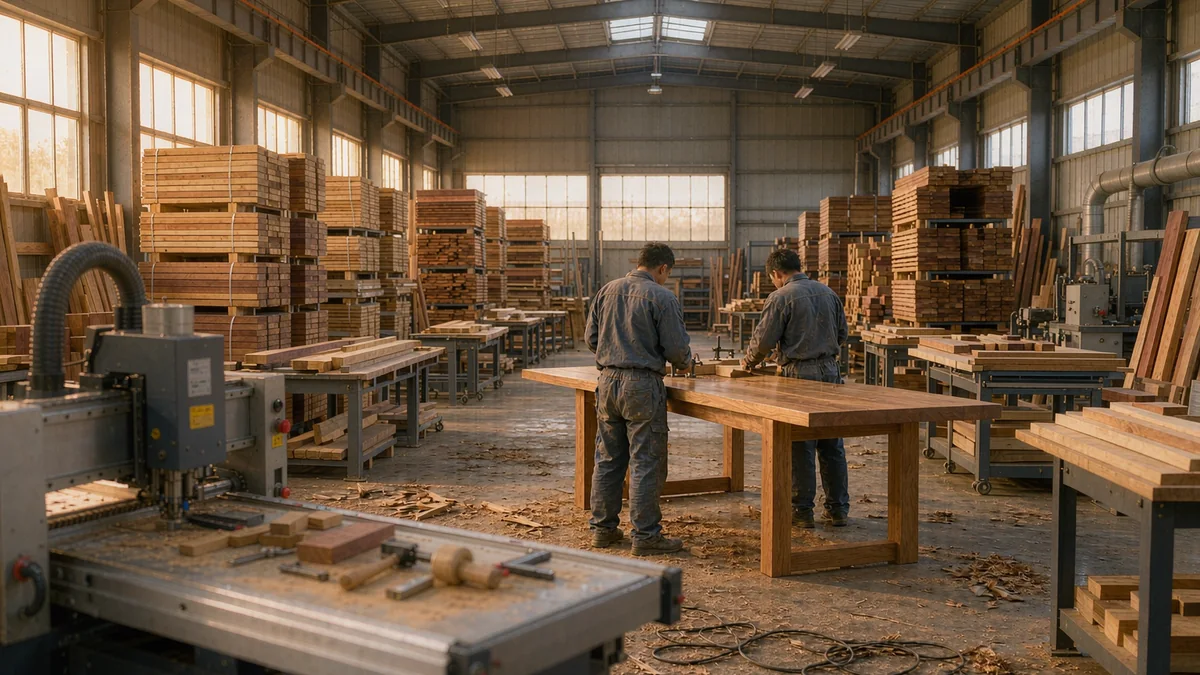
What Is Furniture Actually Made Of — Solid Wood, Plywood or MDF?
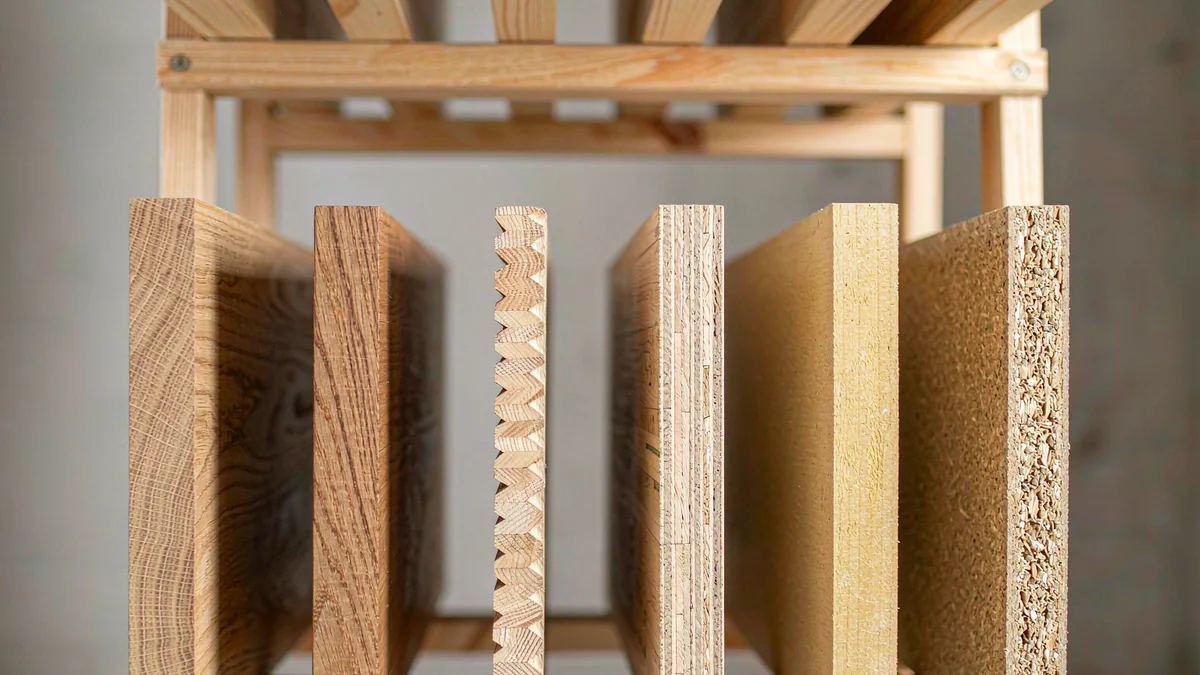
Every furniture failure traces back to the panel, not the finish. A buyer's guide to how each board — solid lumber, edge-glued and finger-jointed panels, plywood, marine ply, particleboard, MDF and OSB — is made, where each belongs, and how to specify it.
On this page
- Why Does the Panel Matter More Than the Finish?
- What Actually Counts as “Solid Wood”?
- How Are Engineered Panels Made, and How Do They Differ?
- Plywood vs MDF vs Particleboard: Which Should Your Order Use?
- Which Panel Belongs Where in a Piece of Furniture?
- How Can You Tell Which Panel a Sample Is Actually Made Of?
- What Should You Write Into the Specification?
Most furniture complaints start with the finish — a scratch, a colour mismatch, a soft spot in the lacquer. Almost all of them end at the panel underneath. A table top that cups, a shelf that sags, a drawer that falls apart when the screw pulls out, a cabinet that swells after one humid summer: none of these are finishing problems, and none of them can be fixed by refinishing. They are panel problems.
A panel’s behaviour is decided by how it was made — whether the wood fibre was left intact or broken down and reassembled with glue. That single difference determines dimensional stability, water resistance, screw holding, weight, repairability and price. Buyers who can read a cut edge can predict most of those outcomes in about ten seconds.
Why Does the Panel Matter More Than the Finish?
Because the finish is replaceable and the panel is not. A sprayed surface can be sanded back and redone in a day; a carcass that has absorbed water and swollen cannot be un-swollen, and a shelf that has crept into a permanent sag stays sagged.
Panel choice governs five things a buyer will eventually feel:
- Dimensional stability — will the top stay flat and the door stay square through a seasonal humidity swing?
- Water behaviour — what happens after one leak, one spilled drink, one wet season?
- Screw holding — can hardware be removed and refitted, or does the second assembly strip out?
- Weight — which drives both your freight cost and the end customer’s delivery experience.
- Repairability — can the piece be sanded back and refinished in ten years, or is it a replace-and-discard item?
Price sits underneath all five. It is entirely possible to build a cabinet that looks identical to a solid wood one for a third of the cost — it just will not behave the same way in year three.
What Actually Counts as “Solid Wood”?
Solid wood means the fibre is intact: the board was sawn from a log, dried and planed, not reconstituted. Within that family there are four distinct products, and they are not interchangeable.
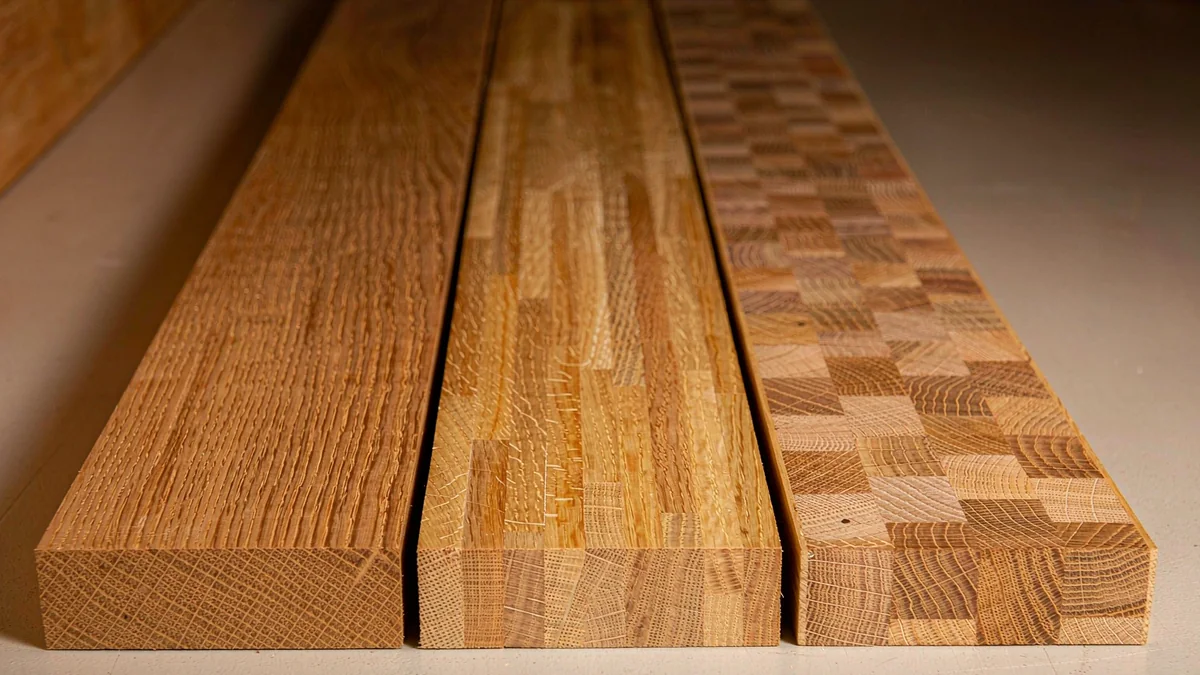
- Solid lumber (原木锯材). Sawn from the log, kiln-dried, planed. Continuous grain, maximum repairability, minimal adhesive — and the highest sensitivity to moisture. Wide one-piece boards are the most expensive and the most prone to movement, which is why they are used selectively.
- Edge-glued panel (直拼板). Narrow strips glued along their long edges into a wide panel. Still entirely solid wood, but far more stable than a single wide board because the movement of each strip partially cancels the next. This is what most quality solid wood table tops are actually made of, including our own Denmark dining table and Laina platform bed.
- Finger-jointed board (指接板). Short lengths of timber joined end-to-end with interlocking “fingers” and adhesive, then usually edge-glued into panels. It makes excellent use of short stock, is very stable and costs less — but the finger pattern is visible under a clear coating, so it normally goes under paint, veneer, or into concealed parts.
- Glulam and LVL. Laminated structural members — layers bonded with structural adhesive. Strong, stable, and used where long spans or curves are needed, such as bed slats and bent components.
The practical point for a buyer: all four are legitimately “solid wood,” and they are not the same product. A quotation that says only “solid wood” has not told you which one you are buying. Ask which, and ask where each is used in the piece.
How Are Engineered Panels Made, and How Do They Differ?
Engineered panels break wood down — into veneers, strands, chips or fibres — and reassemble it with adhesive under heat and pressure. What the wood was broken into is exactly what determines the performance.
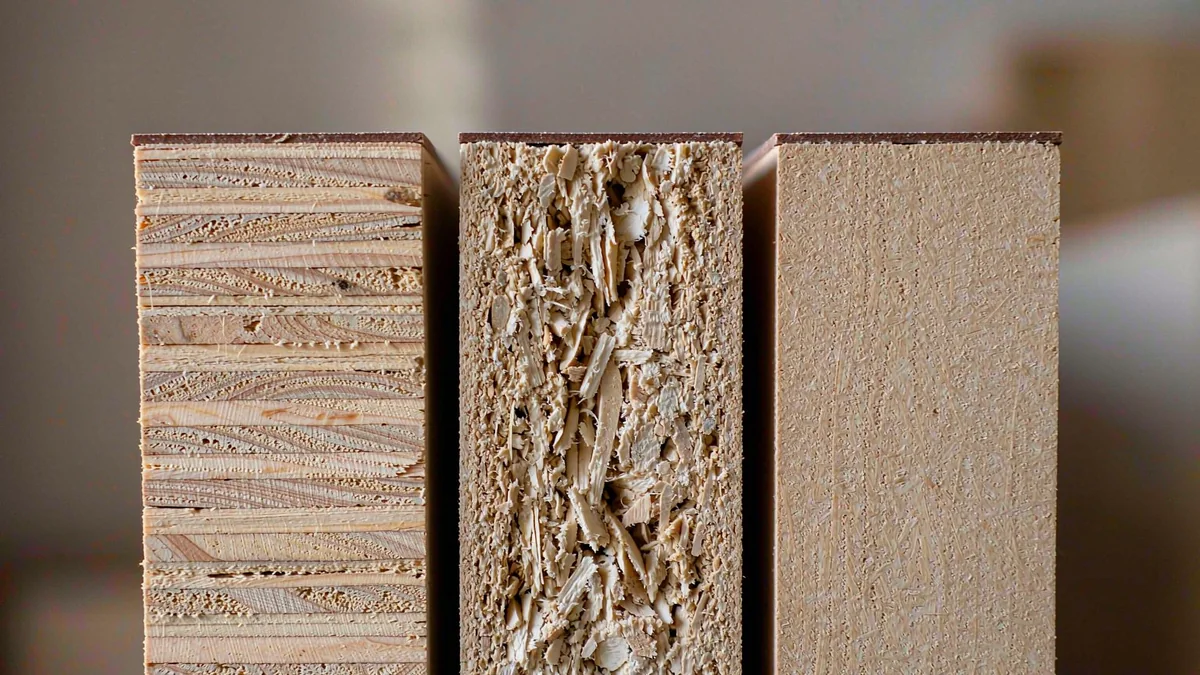
- Plywood (多层板 / 胶合板). Thin veneers, an odd number of them, laid with each layer’s grain at right angles to the one below, glued and hot-pressed. The cross-lamination is the whole trick: it delivers strength in both directions, excellent dimensional stability and good screw holding, including near edges. It is the default for carcasses, shelves, drawer boxes and bed slats.
- Marine plywood (海洋板). Plywood made with void-free veneers and a weather-and-boil-proof phenolic adhesive. It survives repeated wetting that would delaminate interior-grade plywood; it is also heavier and markedly more expensive, so it belongs only where water is genuinely expected.
- Particleboard (颗粒板 / 刨花板). Wood chips and resin pressed into a flat sheet. The cheapest common panel and an excellent, flat substrate for laminate or melamine — which is why most flat-pack and price-driven case goods use it. Its limits are real: it swells badly when wet, and screw holding at the edges is poor.
- MDF (中密度纤维板). Wood fibres and resin, pressed into a homogeneous board with no grain direction. The smoothest surface of any panel, the best substrate for paint, routed profiles and thin veneers — and also the heaviest and the least water-tolerant.
- OSB (欧松板). Large strands oriented in layers and pressed. Excellent structural value, but a rough decorative surface: it shows up in packaging, structural sheathing and hidden substrates far more often than in visible furniture.
- Blockboard (大芯板 / 细木工板). A core of solid timber strips faced with veneer on both sides. Light with good screw holding, but quality varies widely with how tightly the core strips are matched, and voids in the core are a common fault.
- Surfaced variants. Melamine-faced board, veneered board and moisture-resistant “green core” board are not separate materials — they are one of the above substrates plus a surface. The substrate still decides the performance. A melamine-faced particleboard door is still particleboard when water arrives.
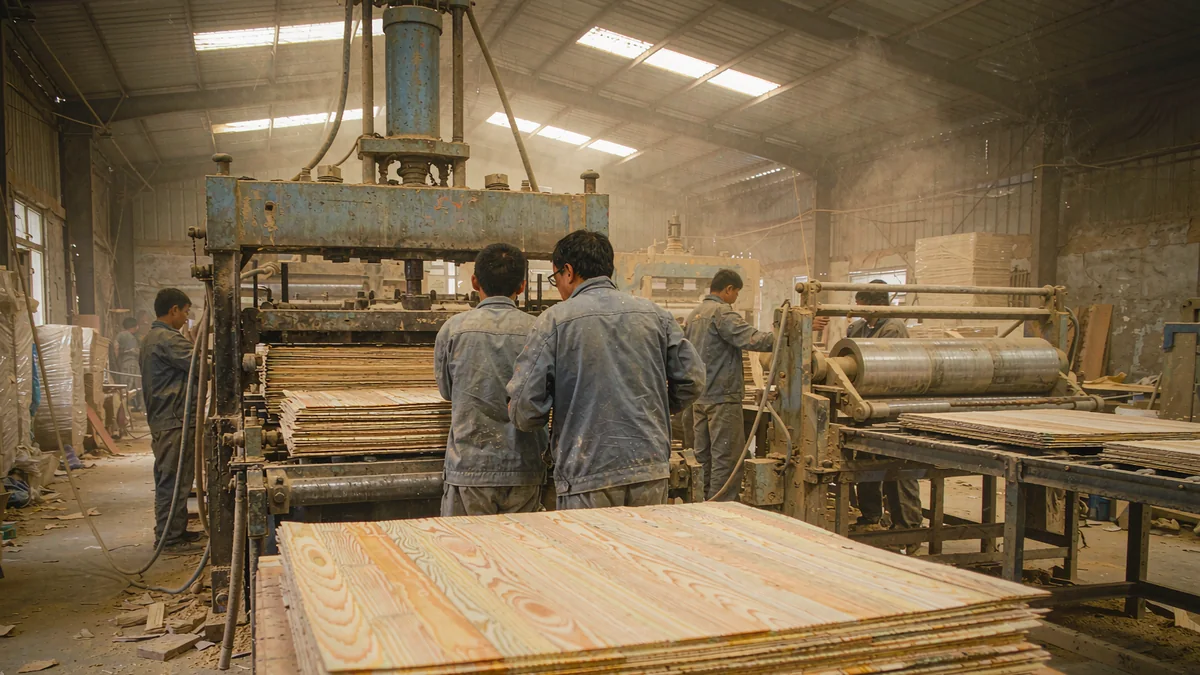
Plywood vs MDF vs Particleboard: Which Should Your Order Use?
Plywood wins on strength, screw holding and moisture; MDF wins on surface smoothness for paint and routed detail; particleboard wins on price and flatness under laminate. The right choice depends on where the panel sits in the piece, what finish it carries, and how humid the destination market is — not on which board is “best”.
| Property | Plywood | MDF | Particleboard |
|---|---|---|---|
| Load-bearing strength | Highest | Moderate | Lowest |
| Moisture resistance | Best (marine grade best of all) | Poor | Poorest |
| Screw holding | Excellent, including near edges | Fair | Poor — crumbles at the edge |
| Surface for finishing | Veneer or paint; grain shows | Smoothest; best for paint and routing | Needs melamine or laminate |
| Weight | Moderate | Heaviest | Light to moderate |
| Cost | Highest | Mid | Lowest |
| Typical use | Carcasses, shelves, bed slats, wet areas | Painted and routed fronts | Flat-pack and budget cabinets in dry rooms |
Three rules that settle most arguments:
- Choose plywood when the panel carries load, spans a distance, holds hardware that will be removed and refitted, or lives anywhere near water.
- Choose MDF when the surface will be painted, routed or wrapped in thin veneer and the piece stays dry — it will stay flatter than solid wood.
- Choose particleboard when cost and flatness matter more than longevity, the surface is factory-laminated, and the edge banding is specified properly: edge sealing, more than the board grade, is what decides whether a particleboard cabinet survives its first humid summer.
Which Panel Belongs Where in a Piece of Furniture?
Honest specification means using engineered panels where they are genuinely better — not pretending solid wood wins everywhere.
| Part of the piece | Best choice | Why |
|---|---|---|
| Table tops, chair frames, visible edges | Solid lumber or edge-glued panel | Repairable, real grain, traditional joinery |
| Cabinet carcasses, long shelves | Plywood | Span strength, stability, screws hold near edges |
| Painted or routed door fronts | MDF | Flattest, smoothest surface; no grain telegraphing |
| Price-driven flat-pack cabinets | Particleboard + melamine | Lowest cost; needs good edge banding |
| Drawer boxes | Solid wood or plywood; bottoms in plywood/HDF | Repeated load and pull cycles |
| Bathrooms, kitchens, coastal humidity | Marine plywood or moisture-resistant board | Survives wetting |
| Bed slats | LVL or plywood | Spring plus stability across the span |
| Concealed backs | HDF or thin plywood | Holds the box square at low cost |
Two cautions worth repeating. First, sag: a particleboard shelf loaded with books will creep permanently, while plywood will not — so span length should drive the panel, not price alone. Second, mixed materials are normal and often desirable: a solid wood frame with a plywood-panel door, or a solid ash frame under a sintered stone top like our Fangao TV stand, is sound engineering rather than corner-cutting.
How Can You Tell Which Panel a Sample Is Actually Made Of?
You can identify almost every panel from its cut edge, in this order:
- Read the edge. Visible thin layers → plywood. Coarse chips and flakes → particleboard. Perfectly smooth, dense, grainless → MDF. Grain that runs continuously through the thickness and wraps around the end → solid wood.
- Check the weight for the size. MDF is the heaviest common panel by a clear margin; plywood is moderate; solid wood varies by species.
- Look at how the screw behaves. Drive a screw near an edge and pull it: particleboard crumbles, MDF holds moderately, plywood and solid wood bite properly.
- Listen. Tap it. MDF gives a dull thud, plywood a more resonant knock, solid wood rings.
- Look for a face layer. If the front looks like oak but the core under an edge chip is clearly something else, you are looking at a veneered panel, not solid oak.
- Ask for the paperwork. A real specification sheet names the panel type, thickness, grade and emission class. Vagueness at this step is itself the answer.
What Should You Write Into the Specification?
Everything above only protects you once it is on the purchase order. Substitution almost never happens by accident — it happens because the order left room for it.
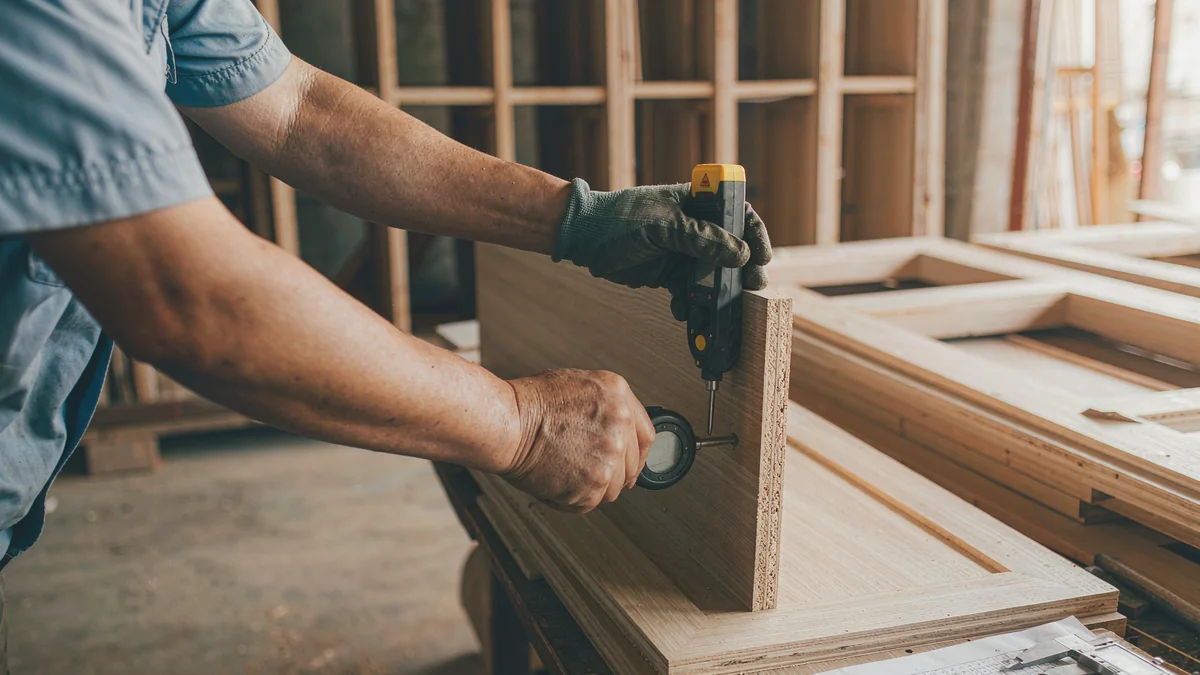
Specify, in writing:
- Species and panel type together — “solid red oak, edge-glued panel” is a specification; “wood” is not.
- Thickness and tolerance — nominal thickness plus what you will accept.
- Grade — lumber grade for solid parts, veneer grade for faced panels, and an explicit statement about which parts may be finger-jointed.
- Moisture content — a target of roughly 8–12% for most export markets, matched to the destination climate, with meter readings recorded per batch.
- Emission class — E1 as the mandatory baseline for China (GB 18580), E0 where a stricter grade is wanted; for the United States, TSCA Title VI / CARB Phase II compliance, which limits hardwood plywood to 0.05 ppm, particleboard to 0.09 ppm, MDF to 0.11 ppm and thin MDF to 0.13 ppm.
- Edge banding — material, thickness and method, because the edge is where moisture enters and where chipboard fails first.
- A substitution clause — any change to panel type, grade or thickness requires written approval before production starts. Substitution clauses belong in the wider agreement too, including who owns the design — see OEM vs ODM furniture.
- Evidence at inspection — panel certificates, moisture readings, and a comparison against the approved sample rather than against the factory’s own standard.
Do that, and the conversation stops being about whether the furniture is “good quality” and starts being about whether it matches a document you both signed — which is a far easier conversation to win. For the same reason, the checks in why an approved sample does not guarantee production and the supplier questions in how to judge whether a furniture supplier is reliable belong in the same purchase order as this panel specification.
Frequently Asked Questions
Is plywood stronger than solid wood?
It depends on the direction of the load. Plywood's cross-laminated veneers make it very strong and stable in both directions across the sheet, so it resists warping and holds screws well near edges — that is why it is the standard for carcasses, long shelves and bed slats. Solid wood is stronger along the grain and can be repaired, refinished and joined with traditional joinery. In practice the best furniture uses both: solid wood where you see and touch it and where joinery matters, plywood where span and stability matter.
Which is better for furniture — plywood, MDF or particleboard?
There is no single winner; each wins on a different axis. Plywood is the strongest, holds screws best and tolerates moisture, which is why it is used for carcasses, long shelves and bed slats. MDF has the smoothest and most homogeneous surface, making it the best substrate for painted and routed door fronts. Particleboard is the cheapest and flattest under laminate and is the standard core for melamine-faced flat-pack furniture, provided the edges are properly banded. Most well-built furniture mixes all three: plywood in the carcass, MDF in the painted fronts, and particleboard only where cost rules and the room stays dry. If you have to pick one for a humid market, pick plywood; for a painted finish, pick MDF; for the lowest landed cost, pick particleboard with a specified edge banding.
Is MDF bad for furniture?
No — MDF is excellent at what it is for. Because it has no grain direction and a perfectly smooth, homogeneous surface, it is the best substrate for painted finishes, routed profiles and thin veneers; a painted MDF door front will stay flatter than a solid wood one. Its weaknesses are water and weight: unprotected MDF swells quickly when wet, and it is the heaviest common panel. Use it for painted fronts and routed details, not for wet areas, load-bearing shelves or anything that will be knocked about in transit.
Does finger-jointed board count as solid wood?
Yes, in the trade sense: the wood fibre is intact, not reconstituted into chips or fibres. A finger-jointed board is made from short pieces of solid timber joined end-to-end with interlocking fingers and adhesive, then often edge-glued into a panel. It is more dimensionally stable and considerably cheaper than wide one-piece boards, and it makes far better use of the log. What it is not is 'one piece of wood' — the finger pattern is visible under a clear finish, which is why it is usually used under paint, veneer, or in hidden parts.
When is marine plywood actually necessary?
Only where the panel will face repeated wetting or sustained high humidity: bathroom vanities, outdoor furniture, boat interiors, coastal projects and anywhere a leak is plausible. Marine plywood uses void-free veneers and a weather-and-boil-proof (WBP) phenolic adhesive, so the glue line survives conditions that would delaminate ordinary interior plywood. It costs significantly more and is heavier, so specifying it across a whole order when only a few pieces need it is wasted money — and claiming it without the certificate is worse.
What do E0, E1 and CARB P2 mean?
They are formaldehyde emission classes for composite wood panels. E1 is the mandatory limit for wood-based panels sold in China (GB 18580) and is also the European EN class, measured by chamber test; E0 is a stricter grade widely traded in China. For the United States, the relevant rule is EPA TSCA Title VI, whose limits are identical to California's CARB ATCM Phase II: hardwood plywood 0.05 ppm, particleboard 0.09 ppm, MDF 0.11 ppm and thin MDF 0.13 ppm. Panels must be certified and labelled. Which class you need depends on the destination market, so name it in the purchase order rather than accepting 'eco-friendly'.
Why does solid wood furniture cost more than panel furniture?
Material yield and labour. Solid lumber must be sawn, kiln-dried to a controlled moisture content, graded and colour-matched, and the yield from a log is far lower than from chips or fibres — a board with a defect is downgraded or discarded, while the same wood becomes perfectly usable particleboard. Solid wood also needs more skilled handling: acclimatisation, grain direction, joinery and finishing. What you buy with the premium is repairability and longevity — a solid oak top can be sanded and refinished decades later, a chipped laminated panel cannot.
Sources & References
Get a furniture quote
Sourcing solid wood furniture for your market? Send us your drawings, target quantities, and destination port — we will reply with pricing, MOQ, and lead time.